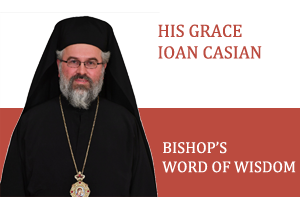
His Grace Bishop Ioan Casian: "Prayer Is Never an Act of Selfishness.
It Is Always an Act of Love."
On the Fourth Sunday after Pentecost, His Grace Bishop Ioan Casian celebrated the Divine Liturgy at Saints Peter and Paul Romanian Orthodox Parish in Kitchener, Ontario, together with Fr. Dragoș Giulea, the parish priest. At the conclusion of the Divine Liturgy, the Bishop delivered a homily inspired by the Gospel account of the healing of the centurion's servant (Matthew 8:5–13), emphasizing the inseparable connection between faith, humility, and prayer.
As the Church prepares to celebrate the Feast of the Holy Apostles Peter and Paul, the hierarch reflected on the lives of these two great Apostles, noting that they reveal the transforming power of God's grace. Saint Peter became a pillar of the Church through repentance, while Saint Paul, once a persecutor of Christians, became the Apostle to the Gentiles after his encounter with Christ on the road to Damascus. Their lives testify that God can transform every heart that is open to His saving work.
Turning to the Gospel of the day, His Grace Bishop Ioan Casian explained that the Roman centurion is a model of the believer whose faith is expressed through action:
“Through the example of the centurion, Christ teaches us that the one who is righteous before God is not merely the one who hears the Law, but the one who fulfills it. Many who considered themselves part of God’s chosen people relied on the fact that they belonged to the same religious tradition, attended the synagogue, and listened to God’s word, yet their hearts remained unchanged. Christ shows that true righteousness consists not only in hearing God’s Law, but in living it.”
The hierarch highlighted the centurion's remarkable concern for his suffering servant: "The centurion comes before Christ to ask for the healing of his servant. He asks nothing for himself. In doing so, he reveals first of all his faith, because he is convinced that Christ alone can bring healing. At the same time, he demonstrates genuine love for his neighbor. His servant's suffering becomes his own."
Drawing also from Saint Luke's account of the same event, His Grace Bishop Ioan Casian noted that the centurion was known not only for his faith but also for his charitable deeds, having helped build the synagogue in Capernaum. "His faith does not remain at the level of words; it is transformed into concrete love for others."
A central point of the homily was the centurion's well-known confession: "Lord, I am not worthy that You should enter under my roof, but only speak the word, and my servant shall be healed."
Reflecting on these words, the hierarch explained: "These words reveal one of the most beautiful professions of faith in the entire Gospel. They reveal, first of all, this man's humility. Although he was a commander in the Roman army, possessing authority over many, before Christ he saw himself only as one who was unworthy. At the same time, these words reveal the depth of his faith."
Commenting on Christ's words, "I have not found such great faith even in Israel," the hierarch emphasized that belonging to a religious tradition is not enough if one's life does not bear the fruits of faith: "The centurion did not belong to God's chosen people. Most likely he was a pagan and a foreigner. Yet it is precisely this man who receives Christ's highest praise. Through him, Christ teaches us that a person is not made righteous simply by belonging to a particular nation or religious tradition. It is not enough to know God's Law, to hear His word, or even to be present in the synagogue or in church. All of these are important, but they must bear fruit in one's life. True faith is revealed in the way we live—in humility, in love for our neighbor, and in the good works we perform. The centurion is praised not because he spoke beautiful words, but because his entire life bore witness to what he believed."
A significant portion of the homily focused on the meaning of prayer. His Grace Bishop Ioan Casian explained that prayer is far more than presenting requests before God; it is a living dialogue between the human person and God, always opening the heart toward others: "The Church continually teaches us to pray for one another. At every Divine Liturgy we pray for the whole world—for the sick, for those who suffer, for travelers, for those who labor, for the departed, and for all who stand in need of God's mercy. Prayer is never an act of selfishness. It is always an act of love."
The bishop also reflected on the Church as a communion rooted in communion with God: "The life of the Church is, in its very essence, a life of communion. Yet this communion among us has its source in our communion with God. We cannot truly learn to communicate with one another unless we first learn to communicate with God. Prayer is therefore the school of true communion. Some may ask why the Church gives us so many prayers—morning and evening prayers, prayers before and after Holy Communion, and so many prayers composed by the Holy Fathers. The answer is simple: because we must learn how to pray. The Church introduces us, step by step, into the school of prayer. It is the school of the spiritual life."
Continuing this reflection, His Grace Bishop Ioan Casian explained why constant prayer is essential:
"The Church calls us to pray without ceasing, not because God does not already know our needs, but because prayer transforms us. It teaches us humility, patience, love, and trust in God's providence. The Gospel we heard today is not only about the healing of a physical illness; above all, it is about the healing of the human heart. The centurion comes before Christ with a humble heart, unwavering faith, and sincere love for his neighbor. It is precisely this inner disposition that makes him worthy to receive the Lord's answer."
In concluding his homily, the hierarch once again referred to the Holy Apostles Peter and Paul, emphasizing that both became great witnesses to Christ because they placed their entire hope in God rather than in themselves. He encouraged the faithful to imitate both the centurion and the two great Apostles by uniting faith with good works, humility with love for others.
Finally, the hierarch prayed that God would grant everyone "such faith, such humility, and such love," so that, following the example of the centurion and through the prayers of the Holy Apostles Peter and Paul, they might attain the joy of the Kingdom of God.
On the parish feast day, His Grace Bishop Ioan Casian elevated Fr. Dragoș Giulea to the rank of Iconom Stavrofor and presented him with the Diocesan Diploma of Merit in recognition of his dedicated pastoral ministry. The Diocesan Diploma of Merit, together with the Centennial Cross of the Romanian Orthodox Diocese of Canada, was also awarded to Constantin Ogradă Bratu, Daniela Elena Ogradă Bratu, Vasile Ivașco, and two additional benefactors who wished to remain anonymous.
The celebration concluded with a festive fellowship meal lovingly prepared by the women of the parish.