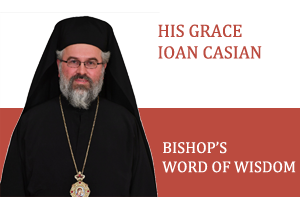
His Grace Bishop Ioan Casian: “The work of the Church cannot be accomplished without God”
On the feast day of the Ascension of the Lord and of Saints Constantine and Helen, at the Episcopal Cathedral of “St. Great Martyr George and Sts. Epictetus and Astion” in Saint-Hubert, Quebec, the Holy and Divine Liturgy was celebrated by His Grace Bishop Ioan Casian, surrounded by a clergy assembly that included Fr. Mircea Panciuk and Deacon Valentin Boțu.
In the homily delivered at the end of the service, the hierarch spoke about the profound meaning of the Ascension of the Lord, the reality of Christ’s Resurrection, and the work of the Holy Spirit in the life of the Church.
Beginning from the Gospel reading of the day, the hierarch emphasized that the appearances of the Savior during the forty days after the Resurrection had the purpose of assuring the disciples that Christ had truly risen, with a real and transfigured body: “If He has risen, He is not some spirit or a legend (...), but He shows them that the body with which He is risen is the one that bears His eternal identity.”
His Grace Bishop Ioan Casian highlighted the episode of the encounter with the Holy Apostle Thomas, showing that the wounds of the Savior remain signs of His love and sacrifice: “The marks of His suffering accompany Him into eternity.”
Referring to the Savior’s words addressed to the disciples — “Touch Me and see” — the hierarch explained that Christ reveals to them the reality of His resurrected body: “My body is the concrete, true, transfigured body after the Resurrection.”
At the same time, the Romanian hierarch pointed out that the entire history of salvation was a preparation for the coming of Christ: “There is a preparatory work of God for the coming of Christ the Savior and for preparing humanity to recognize Him.”
The hierarch then spoke about the message of the kontakion of the Feast of the Ascension: “Uniting earthly things with heavenly ones.” In this context, he spoke about the raising of human nature into communion with God: “Christ takes our humanity upon His shoulders, and at the moment of the Ascension, He raises it into the bosom of God the Father, near the throne of His glory.”
The hierarch also emphasized that God never separates Himself from His creation: “God cannot distance Himself from His creation, because the moment God withdraws from His creation, creation returns to nothingness.”
Speaking about the mission of the apostles and the life of the Church, His Grace Bishop Ioan Casian stressed that the work of the Church cannot exist without the grace of the Holy Spirit: “The work in the Church cannot be accomplished without God or solely through our own human power, energy, and creativity.”
Likewise, the Bishop of Canada explained that the apostolic mission is not merely a human endeavor, but one founded upon the power received from above: “Remain in the city of Jerusalem until you are clothed with power from on high.”
In the second part of the homily, the hierarch recalled the life and contribution of Saints Constantine and Helen to the freedom and spread of Christianity.
He highlighted the essential role of Saint Emperor Constantine in ending the persecutions against Christians and in recognizing religious freedom: “For 300 years, Christians were persecuted. Emperor Constantine is the one who opened the path to freedom for the Christian faith. Churches could be built, confiscated properties were returned, and Christians were no longer persecuted for their faith.”
His Grace Bishop Ioan Casian also noted that many realities considered natural in society today have their origins in the measures implemented by Saint Constantine the Great: “Saint Emperor Constantine supported the Church through numerous measures: he encouraged the construction of churches, granted Christian communities the right to receive donations and inheritances, protected the poor, widows, and orphans, and reduced or abolished the cruel punishments of the time. In 321, he proclaimed Sunday as a day of rest, and in 325 he convened the First Ecumenical Council at Nicaea, where the faith in the divinity of Christ was defended and the method for calculating the date of Pascha was established. With his help the Basilica of the Resurrection in Jerusalem was erected. In 330, he moved the capital of the Empire to Constantinople, and through his mother, Saint Helen, the wood of the Holy Cross was discovered in Jerusalem.”
In conclusion, the hierarch showed that both the Feast of the Ascension of the Lord and the commemoration of Saints Constantine and Helen bear witness to the same calling of humanity toward the Kingdom of God and communion with Christ in the Church.
(notes by Nun Ana Bulgariu)