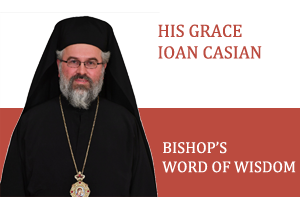
His Grace Bishop Ioan Casian:
The Cross as the Tree of Life – Its Meaning in the Middle of Great Lent and the Priestly Ministry
The Divine Liturgy on the Third Sunday of the Holy and Great Lent, also known as the Sunday of the Holy Cross, was celebrated at the Episcopal Cathedral of St. Great Martyr George and Sts. Epictetus and Astion in St. Hubert, Québec, by His Grace Bishop Ioan Casian, surrounded by a group of priests and deacons: Fr. Mircea Panciuk – Protopresbyter Emeritus, Protosyncellus Maxim Morariu – Ecclesiarch, Fr. Constantin Lupașcu, Fr. Adrian Manea, Deacon Valentin Boțu, and Deacon Marius Constantin Popa.
During the Divine Liturgy, Deacon Marius Constantin Popa was ordained to the holy priesthood on behalf of the Episcopal Cathedral, receiving the calling to fully carry out the sanctifying ministry of the Church.
In the homily delivered at the end of the Divine Liturgy, the hierarch highlighted several important aspects of the liturgical period in which we find ourselves.
The Sundays of Lent – Spiritual Stopping Places
From the very beginning, the hierarch emphasized that the Sundays of Great Lent are “spiritual stopping places,” stages of an inner pilgrimage that structures our spiritual life:
“Each Sunday of the Fast is a spiritual resting place. It is a journey, a pilgrimage that we undertake, which places before us these milestones—the Sundays that guide our thinking, our spiritual life, and the particular character of what we do in the Church. They help us deepen our spiritual experience through the events we celebrate. In this succession—the Sunday of Orthodoxy, the Sunday of Saint Gregory Palamas, and the Sunday of the Holy Cross—the faithful are called to enter ever more deeply into the mystery of the life of Christ and of the Church.”
The Cross – The Tree of Knowledge and the Tree of Life
Speaking about the theological significance of the day, the Bishop of Canada explained that the Church sees the Cross both as the tree of the knowledge of good and evil and as the Tree of Life in the midst of Paradise. The Cross on which Christ was crucified and died as a man becomes for us the gateway to the Kingdom of Heaven:
“The Cross on which Christ was crucified—He died as a man but rose on the third day—is the sign through which we may have access, insofar as we personally enter into the experience of the Savior, to the Kingdom of Heaven.
Nothing can be accomplished without the Cross. We cannot see the Resurrection of Christ without passing through His Cross.”
The gift of the Resurrection, redemption, and forgiveness of sins does not come from our moral effort but from the work of Christ:
“We have been given this gift of the Resurrection, the gift of redemption, the gift of the forgiveness of sins; it has been given to us through the power of Christ, not through our personal power. We follow the example of Christ, but the One who accomplishes the entire work within us is Christ Himself.”
The Ministry of the Priest – A Calling, Not a Personal Initiative
The homily was naturally connected with the ordination of the new priest of the Cathedral. Referring to the Epistle to the Hebrews, the bishop explained the nature of the priestly calling:
“Every high priest, taken from among men, is appointed for men in things pertaining to God, to offer gifts and sacrifices for sins. The servant of God is taken from among all of us, from those who feel this vocation, prepare for it, and whom the Church recognizes and entrusts in Christ with the gift of the priesthood.”
The call to ministry is not the result of self-proclamation: “No one takes this honor upon himself. No one rises to the dignity of bishop, priest, or deacon by himself. One may be a good preacher and speak beautifully about God, but the sanctifying work of the Divine Liturgy and of the Holy Mysteries can only be carried out when Christ entrusts it to you in the Church through the grace of ordination. This order continues directly the practice and life of the Apostolic Church.
If you read the New Testament, you will see that this was the practice of the Church from the beginning. As servants of the Church, we do nothing other than live the same life that the Church of the Holy Apostles lived. Therefore, the Church cannot yield to worldly pressures to ‘adapt’ to the point of changing its dogmas and essential practices.
There can be no compromise in matters of doctrine or essential practices of our faith. If we depart from what the Apostles did, we can no longer call ourselves the Church, because we would no longer represent what they received from Christ and handed down to us.”
Contemporary with the Apostles Through the Holy Spirit
The hierarch emphasized that the Church is not merely a historical institution but also the place where the Holy Spirit makes present the same experience lived by the Apostles:
“The Church is not only a historical institution; it is not merely an event that took place two thousand years ago. The Holy Spirit makes the Church of that time present today. This makes us contemporaries of the Apostles: as individuals we live many centuries later, but in the life of the Church we are their contemporaries, because both they and we live the same experience in the Holy Spirit.”
The calling received by the newly ordained priest continues this same mission: “The calling that the priest receives is a calling from Christ, who invites him to a mission and a responsibility: to take upon his shoulders the proclamation of the Gospel, the communion of the faithful in the Body and Blood of Christ for eternal life, and the fulfillment of the entire sanctifying work of the Church in His name, the name of the Son of God. Once ordained, we perform the work of Christ through the grace He gives us, but we cannot replace Him in His unique work.”
“Whoever Desires to Come After Me…” – The Three Conditions of Discipleship
Commenting on the Gospel according to St. Mark—“Whoever desires to come after Me…”—the bishop explained that following Christ is a free but very concrete commitment:
“Following Christ is a free choice: ‘whoever desires to come after Me.’ If someone wishes, there are three conditions.
‘Let him deny himself’—this does not mean abolishing one’s person but renouncing passions and habits that are not in accordance with life in Christ. We cannot destroy ourselves, because we are all God’s creation. Self-denial means gradually eliminating, through ascetic effort and the reception of grace, the passions and habits that are not characteristic of holy life in Christ.
‘Let him take up his cross’—that is, to follow the path that Christ Himself followed, although He was without sin. Christ followed the path of the Cross without sin; the Cross was not a punishment for His sins but something He assumed on our behalf so that we might be saved. To take up one’s cross means to follow Christ’s path, which is not an easy one.
The Christian life is not necessarily comfortable. If a sinless man such as Christ encountered so much opposition, we can imagine how much opposition we will face, we who also carry our sins. The Christian life is not always the easiest path.
‘And follow Me’—this implies a journey that lasts a lifetime. The path Christ asks of us is to follow His example, because this is obedience to the will of God the Father, who entrusted Christ with His mission. If we follow Christ, we follow the will of God the Father and participate in the work of God.”
Truth That Disturbs and the Freedom of Faith
The Bishop of Canada also explained that following Christ means embracing the truth, even when it brings confrontation with the world:
“A life of witness is a life lived in truth. And we know well that the truth is not always easily accepted. Often it disturbs. God is the Way, the Truth, and the Life. The truth that we live in our lives means the presence of God within us, and this inevitably disturbs those whom the truth rebukes.
Even if we no longer live under the brutal persecutions of the early centuries, pressures against faith remain. Today there are other constraints—legal, cultural, and social—that attempt to hinder the free expression of faith. God does not necessarily promise us an easier life, but He promises eternal life.”
Moving Away from the Light
In conclusion, the bishop used the image of light to describe the distancing of a person from God:
“You cannot distance yourself from the service of Christ and still say that you remain in the Church. It is like moving away from a source of light. The light remains in the same place; you move further and further into darkness. God does nothing to you—you yourself move away from His light.”
The person who lives in God’s presence has peace of conscience; restlessness appears when the bond with God is broken. The person who lives in God does not have these inner torments, because he knows that God is present. The moment you begin to distance yourself, the conscience begins to trouble you, because it senses that the foundation upon which man was created—faith, the work of God, His grace—is no longer there.”
The Cross in the Middle of Lent – An Encouragement to Continue
Concluding his homily, the Bishop of Canada reminded the faithful that we are now in the middle of Great Lent, and that the Sunday of the Holy Cross is placed here precisely to strengthen and encourage us:
“We are, in a way, approaching the middle of theGraet Lent. The Sunday of the Holy Cross stands in the middle of Great Lent just as the Tree of Life stood in the middle of Paradise. The Cross of Christ is the tree of the knowledge of good and evil that propels us further in this pilgrimage toward Holy Week—toward the Entry into Jerusalem, the Passion, the Crucifixion, Death, Burial, and finally the joy of the night of the Resurrection, when we proclaim: Christ is risen!
Great Lent is an ascetic and spiritual journey, a path of effort and communion with God that leads us toward His Resurrection.”
In this spirit, the faithful were encouraged to continue their Lenten ascent, keeping their eyes fixed on the Cross of Christ, “the Tree of Life” at the center of the Church and of every Christian life.
(notes by Nun Ana Bulgariu)