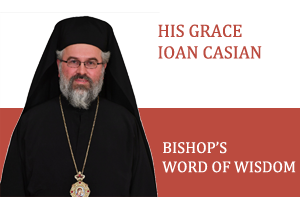
His Grace Bishop Ioan Casian: The Saints Show Us That Salvation Is Possible
for Every Person, Regardless of Their Falls
On the occasion of the feast of Saint Parascheva the Venerable, His Grace Bishop Ioan Casian celebrated the Divine Services at the Episcopal Cathedral “Saint George the Great Martyr and Saints Epictetus and Astion” in Saint-Hubert, Québec, Canada.
The celebration began on Monday evening with the Vespers service united with the Litia and the Akathist of Saint Parascheva, followed by a procession with the reliquary that holds a vestment of the Saint.
The next day, the joy of the feast continued with Matins and the Divine Liturgy. Concelebrating with His Grace were Protosyncellus Maxim Morariu, Father Teofil Arsene, and Deacon Valentin Boțu.
In his homily at the end of the Divine Liturgy, the bishop spoke about the spiritual and historical significance of venerating Saint Parascheva, as well as about the personal calling to holiness. He recalled the history of the bringing of her relics to Moldavia in 1641, during the reign of Prince Vasile Lupu, who paid off the debts of the Ecumenical Patriarchate, which was then under Ottoman rule. The bishop emphasized that, over the centuries, the Romanian principalities supported Christian life in the Middle East through donations, income from dedicated monasteries, other financial aid, and the printing of liturgical books. In this spirit of sacrificial faith, the Church has remained a witness of fraternal love.
Starting from the words of the Gospel of Mark – “If anyone wants to follow Me, let him deny himself, take up his cross, and follow Me” – the hierarch explained how these words marked the entire life of Saint Parascheva: “The life of Saint Parascheva shows us that holiness can be attained at any age. Although she passed away before reaching thirty, she attained perfection through faith, ascetic efforts, and the grace of God.”
Speaking about the three stages of the spiritual life, the Romanian bishop of Canada noted:
“Man is called not only to live a physical life but also a spiritual one – the life of the soul. Living only for the material dimension means remaining inwardly empty, because true fulfillment is found only in the light and work of God. The Savior offers the key to this spiritual growth: ‘If anyone wants to follow Me, let him deny himself, take up his cross, and follow Me.’ These three steps – self-denial, taking up the cross, and following Christ – correspond to the three stages of the spiritual life: purification, illumination, and deification.
Purification involves renouncing passions and acquiring virtues. Illumination brings the vision of the meaning of life and the world through the eyes of God and a spiritual understanding of Holy Scripture. One comes to understand the purpose of existence more deeply; inner vision is enlightened, and reality is no longer seen through the lens of selfishness, but through the light of God's grace.
Deification is the union of the human being with God through the grace of the Holy Spirit – the measure of perfection. In this state, human powers are overwhelmed by the mysterious work of the Holy Spirit. A person's life becomes a reflection of the life of Christ, and he works together with God in all that he does.”
Throughout life we realize that we are fragile – like clay vessels – subject to illness, trials, and hardships. But the light of God can dwell in us if we receive Him through faith and purify our lives. This is how the saints lived, and this is how Saint Parascheva lived. The saints show us that salvation is possible for every person, regardless of their falls.”
His Grace Bishop Ioan Casian further spoke about God’s constant presence in a person’s life:
“God is present in every moment of our lives: through His providence, through His work, through the inspiration He gives us, and especially through the very life we receive as a continuous gift. The life we feel in our bodies is only one part of our existence – the material, physical side – which is also sustained by the power of God, without whom nothing can exist. But beyond this bodily life, there is another level of existence – the spiritual life, the life of the soul, in which we are called to grow. Man is made up of body and soul; the body receives life through the blessing of God, and the soul is His life-giving breath.”
The bishop then emphasized that holiness is not reserved for a select few but is a calling for all. The Apostle Paul, the thief on the cross, and many other saints – all demonstrate the fragility of our human nature, which God knows. He desires from us a sincere desire for change and repentance:
“God allows man to first see the wounds of his soul, so that later, through His grace, healing may begin. This is why we need the Church, the Holy Mysteries, spiritual guidance, and the example of the saints. This is the spiritual life, and this is the measure that Saint Parascheva reached. That is why it is important to read the lives of the saints – they show us concretely that the Gospel can be lived even today. The life of Saint Parascheva is a testimony that God is alive and working in the world today. Through her prayers, we receive courage, light, and strength on the path of faith.”
At the end of the service, those present received the final blessing.
(notes by Nun Ana Bulgariu)