The feast of the Exaltation of the Holy Cross at the Romanian Orthodox Monastery in Mono
The Cross – The Power of God and the Mystery of True Communion
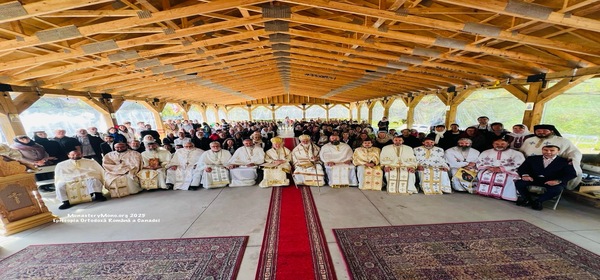
Between September 19-20, the Monastery of the Elevation of the Holy Cross and St. Ephraim the New, located in Mono, Ontario (Canada), celebrated a joyous occasion: the consecration of the summer pavilion, a moment that crowned more than three years of work and dedication by Abbot Polycarp Athenagoras and those who supported him throughout the project.
The celebration began on the evening of Friday, September 19, with a Vigil service dedicated to the Feast of the Elevation of the Holy Cross, the patronal feast of the monastery. The Vigil was followed by the blessing of a reliquary that will house an epitrachelion (priest’s stole) that has been touched to the relics of Saints Cleopa and Paisie of Sihăstria. The services were celebrated by His Grace Bishop Ioan Casian, together with Hegumen Polycarp. Responses were offered by a group of chanters including Cosmin Mardare and Mădălina Enache.
On the morning of Saturday, September 20, the Akathist to the Holy Cross was chanted, followed by the Divine Liturgy celebrated by His Eminence Mitrofan, Serbian Orthodox Metropolitan of Canada, and His Grace Bishop Ioan Casian. The liturgical gathering included the following clergy: Fr. Petrică Busuioc (administrative vicar), Fr. Viorel Țencaliuc (dean), Fr. Grigorie Țăpuc (dean), Hegumen Polycarp, Fr. Emanuel Țencaliuc, Fr. Călin Toderiță, Fr. Mihail Cristea, Fr. Marian Iacobuț, Fr. Jovan Marjanac, Fr. Thomas Bekurishvili, Fr. Paul Tadros și Fr. Timothy Mikhail..
At the end of the Divine Liturgy, the ribbon-cutting ceremony for the Summer Pavilion took place, followed by the prayers of blessing and consecration. The pavilion has been placed under the protection of Saints Cleopa and Paisie of Sihăstria.
In his sermon at the conclusion of the event, His Grace Bishop Ioan Casian emphasized several key elements of the Feast of the Elevation of the Holy Cross, saying:
“Our calling is one that helps us understand life from the perspective of the Cross and Christ's sacrifice.
Christ is the Son of God, and the Holy Apostle Paul, in the epistle read today, urges us to view our lives through the lens of the Cross, through the sacrifice of the Savior. He tells us, ‘Consider your calling, brothers’ — as we find in the First Epistle to the Corinthians — and reveals something essential: God has not chosen, throughout salvation history, the powerful or renowned.
Often, He has called the foolish in the eyes of the world to shame the wise; He has used the weak things of the world to confound the strong; He has lifted up the humble and seemingly insignificant to bring down the pride of the mighty. We see this in many episodes of salvation history.
In the Old Testament, we have the example of Moses. In the New Testament, Christ could have chosen scholars of the Law or priests of the Temple, but instead, He called simple fishermen from the shores of Galilee.
What does St. Paul teach us? That God’s wisdom does not always align with human wisdom. Often, God works through the weakness and apparent insignificance of some in order to reveal His power. It is precisely in this weakness that the mystery of salvation is revealed.”
His Grace Bishop Ioan Casian continued by underlining the perfect communion of Christ with the Father:
“The Savior never acted outside the will of the Father. His communion with the Father and with the Holy Spirit is perfect. Even though He became man, He remained, at every moment, in deep communion with the other Persons of the Holy Trinity. The words He spoke were not merely human reflections, but the Word of God the Father, spoken through the human person of the Son.
God chose for His incarnated Son to proclaim the mystery of the Kingdom in our human language, and what the Apostles heard and testified — what we proclaim — springs from that divine revelation.”
The hierarch explained that the communion of the Holy Trinity is the model for ecclesial communion:
“This spiritual communion — the perfect unity of the Father, the Son, and the Holy Spirit — is the foundation of Church life. It mystically reflects the unity the Church is called to embody: one God in three Persons, a communion that remains a model and source of life for us, surpassing our human understanding.
Yet our human, ecclesial communion can reflect it — and to a much greater degree than any earthly, bodily, or natural human connection. Man has both body and soul, and in this dimension, there is a natural connection among people. But in the Church, there is a much deeper communion — a spiritual communion of love, a fellowship born and nourished through partaking of the Body and Blood of Christ, through participation in the Holy Mysteries.”
The Romanian hierarch also spoke of the saints as guiding examples of holiness and protection:
“Among the patrons of this monastery are Saints Cleopa and Paisie, two vocations that may seem different at first glance: Saint Cleopa — a renowned preacher, ascetic, and man of the Word — and Saint Paisie — a great man of prayer and silence. Before God, however, they both stand as witnesses of the same holy life.”
At the invitation of Bishop Ioan Casian, His Eminence Mitrofan shared with the faithful his experience during his four years of theological studies (1971–1975) at the Faculty of Theology in Bucharest, recounting important moments from his encounters with some of the recently canonized Romanian saints, including Saint Dumitru Stăniloae (his professor), Saints Ilie Cleopa and Sofian Boghiu.
The event concluded with a festive agape meal, attended by all participants.