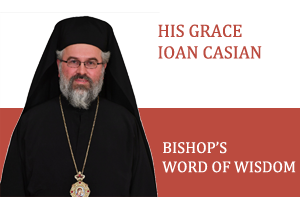
His Grace Bishop Ioan Casian: Human life – an experience of encounter with God, and holiness – the natural state of a life freely lived in obedience to Him
On the 11th Sunday after Pentecost, His Grace Bishop Ioan Casian celebrated the Divine Liturgy at the Episcopal Cathedral in Saint-Hubert, Québec, surrounded by a group of priests and deacons, including: Protosyncellus Maxim Morariu, Fr. Adrian Manea, and Deacon Valentin Boțu.
In his homily at the end of the Divine Liturgy, the bishop highlighted some of the key elements from the two scriptural readings of this Sunday.
“The scriptural texts of this Sunday offer us a precious teaching: the human life is called to reflect the light and the experience of the encounter with God – through His creation and through the relationship He establishes with us and with the entire universe.
Saint Paul the Apostle, in his First Epistle to the Corinthians, speaks about his own sufferings, which he endures not for his personal glory, but to show that the Christian life is not, as we might be tempted to believe, a comfortable or easy life.
The One who should have received the admiration of the world, our Savior Jesus Christ, was crucified like a condemned criminal. This is the great question He puts before us – not just through words, but through His very life: how can we remain anchored in our human securities when His life reveals the opposite? Christ's example should shake the foundations of our thinking and bring us face to face with reality: the Christian life is not a path to earthly glory, but a path of sacrifice.”
The Romanian hierarch then emphasized that this message is very relevant to today’s world:
“Today, although we live in a democratic world, we find ourselves in a modern society that is not always friendly to the values of the Gospel. That’s why Christian vigilance and uprightness are necessary. As Church – meaning both communities and individuals – we are called to bear witness to the faith and take on the responsibility of being Christians; not through violence, but through a peaceful attitude, through courage and perseverance, showing the world that the Gospel, inspired tradition, and Christ’s example have brought and continue to bring real benefits to society.
Saint Paul says, ‘We endure all things so that we do not hinder the Gospel of Christ.’ This is the true Christian attitude. The average person thinks about what they can gain for themselves. The Christian, however, asks: How can I, in my situation, make Christ’s word – His Gospel – heard?”
The bishop stressed that the Gospel is not just a theory, but a living, transformative reality:
“The Gospel is not an abstract notion. It means understanding and showing the world how Christ, through His sacrifice, accomplished our salvation, and how, by embracing this truth, we are transformed and become true people of the Kingdom.
That is why the responsibility of proclaiming the message of salvation in Christ is not limited to bishops, priests, or deacons. Through Baptism, every Christian receives the same mission: to proclaim the Gospel. This is our calling, regardless of the roles we have in our families or in society.”
Commenting on the Gospel reading, His Grace Bishop Ioan Casian explained the symbolism of the parable:
“Today’s Gospel reminds us that the Kingdom of Heaven is like a master settling accounts with his servants. In the same way, at the end of our lives, Christ will settle accounts with each of us – those to whom life and God’s gifts have been entrusted.
This parable is an image of the relationship between God and humanity. The master represents Christ, and the immense debt symbolizes the sin accumulated by humankind since the fall of Adam – a debt no human could pay on their own.
Therefore, in His divine economy, God ordained the coming of Christ at the appropriate time. Humanity first needed to experience, over the course of history, that even with the help of God through the prophets, patriarchs, and righteous of the Old Testament, it could not save itself from sin and its consequences. The coming of the Messiah, Jesus Christ, showed that redemption is not within human power but is a gift of God's love and mercy.”
The hierarch also emphasized the importance of the Sacraments in the life of every Christian:
“In the Sacrament of Confession, we do not stand before a man, but before Christ Himself, who, through the hand of the priest, forgives our sins and restores our relationship with Him.
God gives us new birth through Baptism, strengthens us through Chrismation, nourishes us through Holy Communion, cleanses us through Confession, and blesses family life through the Sacrament of Marriage by granting us the gift of children.
This is the true rebirth: returning to a life of holiness. Holiness is not a special state reserved for a chosen few; it is the natural state of life, as God created it. What we call ‘normal’ today – a life of sin that includes violence, lies, manipulation, and injustice – is a distortion we’ve grown used to. But true normality is the life of Paradise, in communion with God.”
In conclusion, the bishop reminded the faithful of the profound meaning of the Christian calling:
“The Tree of the Knowledge of Good and Evil is the image of human freedom, which means listening to God's word. The fall was the breaking of that relationship. Christ, through His obedience, teaches us to return to that relationship, so we may live in the natural order God gave us.
The example of today’s parable calls us to a life of forgiveness, Christian responsibility, and rebirth in Christ, as a preparation for the final encounter with Him in the Kingdom of Heaven.”
At the end, all those present received the blessing.
(notes by Nun Ana Bulgariu)