The Healing of the Blind and the Mute
Becomes a Pedagogy Toward Trust in God's Active Power in Our Midst
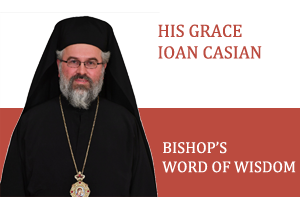
On the 7th Sunday after Pentecost, His Grace Bishop Ioan Casian celebrated the Divine Liturgy at the Episcopal Cathedral of St. George the Great Martyr and Saints Epictetus and Astion in Saint-Hubert, Québec. Among the concelebrating clergy were: Fr. Mircea Panciuk, Prot. Maxim Morariu, Fr. Adrian Manea, Deacon Marius-Constantin Popa, and Deacon Iulian Amohnoaie.
In his homily, referring to the passage from the Epistle to the Romans of St. Paul the Apostle, which was read during the Divine Liturgy, the hierarch emphasized several important points:
“We often have the tendency to complain. We see ourselves as the most tested or the ones who suffer the most. Yet it is enough to look around ourselves with a pure heart and sincere mind, wherever we may be. You will always find someone poorer, more afflicted, or even more virtuous than yourself.
This sincere look toward our neighbor should awaken in our hearts the feeling of true solidarity – a solidarity that goes beyond mere words or fleeting emotions and turns into acts of support and active love. A love that builds.
St. Paul the Apostle urges us: “Let each of us please his neighbor for his good, to build him up.” This is the essence of Christian love: not every apparent “good” is truly constructive. In a society where the word love is used everywhere – from advertisements and press articles to ideological speeches – we risk forgetting that not every so-called love is salvific.
True love does not encourage confusion but illuminates the path. It does not approve every desire but seeks the real good, often through prudence and measure. Not everything shouted loudly in the name of freedom or compassion is truly for the good of humanity.
Great empires did not fall due to lack of resources or power, but because they lost their authentic values. An example is the ideological regimes of the last century that promised utopian equality but instead brought death and suffering. If an ideology produces so many conflicts and victims – over 90 million deaths in the case of communism – then the model it proposed was certainly not one close to Christian and Gospel values.
True solidarity, therefore, is that which is based on truth, faith, hope, and love. It is the solidarity grounded in the values of the Kingdom of Heaven – values that do not fade, do not divide, but unite and illuminate.”
Regarding the miracles described in the Gospel reading from Matthew chapter 9, the hierarch pointed out that “the address ‘Son of David’ is not accidental. It places Christ within the Messianic tradition of the people of Israel, alongside Moses, Isaiah, Elijah, and the other inspired prophets. The two blind men call Him this not only with hope but with the firm belief that He is the awaited Messiah, the One who can heal not only the body but also the soul.
The miracle takes place as a work of divine mercy and as a strengthening of the faith of those present. The healing becomes a public lesson about the power of trust in God.
The two blind men, overwhelmed by the joy of regained sight, cannot keep it to themselves, even though the Lord asks them to tell no one. ‘Out of the abundance of the heart the mouth speaks’ (Matthew 12:34), and thus they become, unintentionally, heralds of the Gospel. Their joy is understandable. To regain this sense means to reclaim your autonomy, your relationship with the world, and your dignity.”
Regarding the healing of the mute man, the hierarch said that “we are shown not only another form of illness but also the presence of personalized evil, of demonic activity.
Even today, the world feels fear in the face of evil — sometimes exaggerated, other times ignored. But it must be clearly said: the power of the evil one relies on the weakness of our faith. Where there is a lack of trust in God, the evil one finds fertile ground. More than once, Christ says to His disciples: ‘O you of little faith, why did you doubt?’ (Matthew 14:31).
True faith does not mean naivety or lack of prudence or measure. It requires discernment. St. Paul the Apostle completes this teaching by calling us to solidarity: with the weak, with those in need, with those who do not yet know Christ. But not a blind solidarity, rather one that builds.
The Savior Jesus Christ comes not only as a healer of the body but also as a teacher of souls, as the one who opens heaven for those who believe. Each of us is called to be a witness of this faith – through life, word, solidarity, and discernment.”
Finally, His Grace Bishop Ioan Casian reminded all present of the large-scale project to renovate the basement of the episcopal cathedral, “a project aimed at further strengthening this community and which, through our joint effort, can become a vibrant and space open for everyone. The plan involves a complete redesign of the lower hall, so that it can host a variety of community activities: from baptisms and weddings, to book launches, conferences, cultural evenings, receptions, or workshops for youth and children. The space will be designed flexibly, so it can be used as a whole or divided into two or three distinct zones, depending on needs.
For this plan to become reality, we need everyone’s support. Whether you are active members or simply supporters, whether you are Romanian or of another background, for whom Christian values and the model of community life that the Church proposes to today’s world are central, we invite you to stand with us. Our hope is that, by next year, this space will be fully functional and become a concrete support for our mission in society.”
The day concluded with a traditional meal held in the cathedral’s inner courtyard, to which all those present were invited.
(Notes by Nun Ana Bulgariu)