All Saints Day in Toronto
All Saints Parish in Toronto these days has been decked out in festive clothes. On Saturday 10 and Sunday 11 June, on the patron saint day, the parish received the visit of HG Bishop Ioan Casian.
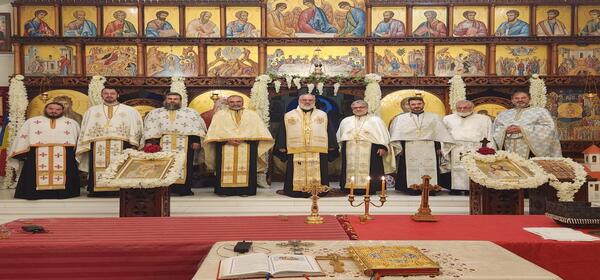
On Saturday evening, the service of Anointing of the sicks was performed, at which the hierarch was joined by Rev. Fr. Viorel Țencaliuc - archpriest, Rev. Fr. Petre Busuioc - eparchial inspector, Rev. Fr. Emanuel Ionuț Țencaliuc - parish priest, Rev. Fr. Lucian Azoiței, Rev. Fr. Mihail Cristea, Rev. Fr. Călin Toderita, Hieromonk Polycarp - hegumen and Rev. Fr. Marian Costinel Iacobut.
The celebration continued the next day with the Hierarchical Divine Liturgy.
"The feast of all saints is the feast of all those who have fought throughout time (in the Old Testament, in the New Testament and until the end of the ages) on the path towards God, a way that not only always causes joy, but also enemies, evil and so on – said the hierarch. So it was with the Savior Christ, the One who is par excellence our model, the One who healed, resurrected people from the dead, spoke with great power, instilled hope in all humanity through His disciples, and Who at the end the three years of public preaching ‘deserved’ only enmity, false witness, and a perverse judgment, recognized even by Pilate (I find no fault in this Man). Thus, for Pilate (but we also see in the society in which we live) it did not matter who and what He did, but it was important to have the administrative peace that the authority wanted to have."
Referring to what the life of holiness means in the Church, the hierarch said:
"Holy Scripture brings us examples that stand as testimonies from which we can learn to have the verticality that the Savior Christ showed and to which we are called to become partakers. In the Church we become partakers of God's life, we are called not only to be pious, faithful people, but also to live God's life, through His gift that is given to us by Him. We are gods by grace, through the fellowship that God gives us in the holiness of His divine life.
In the Epistle read today, St. Paul speaks about the cloud of testimonies of the Old Testament that he knew very well, but at the same time, he says that God did not want to send his Son sooner because the joy of eternal life, of the grace of salvation, of redemption, may He not only give it to those who confessed in the past, but also give it to us today, who follow them as disciples of Him and of the Holy Apostles.(...)
The cloud of testimonies that we have in the Church are the saints. Holiness is not something that we as humanity could acquire by ourselves. That is why the Son of God had to come down from heaven, because the entire chain of generations of the human race could not, although they received God's blessing, step forward, escape their condition as sinful human persons."
The hierarch then spoke about the connection that the Holy Mysteries make between the saving work of Christ for us and each of us:
"Christ the Redeemer brings us the purification of our lives, which for us means baptism. Thus, the primary condition of life that God gave us in the beginning is restored. All our sins as humanity are forgiven. Christ is the Initiator of this path to holiness for us. Baptism is the connection between the work of the Savior, His sacrifice, death and Resurrection and our personal life. The history of our salvation begins with Christ: Jesus, the originator and fulfiller of our faith. Therefore, in the Church, our indecency or arrogance have no place at all, because we are neither the beginners of our path nor even the ones who crown or complete it. We only benefit from the work that Christ the Redeemer does. He comes for our salvation, he speaks, he preaches, he resurrects, he heals, but nevertheless, our human response has been the condemnation of an innocent man, the sinless God Himself. Knowing all this in advance, in order to create this connection with our humanity, He descends from heaven, becomes incarnate from the Virgin Mary, is crucified on the cross, dies, raises on the third day, testifies for 40 days to the disciples that He is truly risen, He ascendes to heaven with our assumed humanity in His person and gives us at Pentecost the great gift of the Holy Spirit. He is the One who fulfills our life. No matter how hard we try, either individually, as a community, or as humanity, we cannot achieve holiness by ourselves. Thus is a gift from God. It is true that He also does it according to our faith, but that is why we call grace a gift. It is a gift from God, received freely, for the purpose of seeing us once again flourishing as humanity, as He intended from eternity, from the beginning, before He created it.”
Today's Christian must be vigilant in the world in which he lives. Our ancestors did the same thing, Bishop Ioan Casian said:
"The love of God is fundamental, because it keeps us in the true life of holiness, in our true identity. There are many ideologies and doctrines in the society we live in, but we all know that the result of some of these, which many of us lived through during the communist period, resulted in millions of deaths. Thus, we must understand that not everything we are told, offered as information, as teaching, is always the most appropriate. Scripture has a very clear criterion: the tree will be known by its fruits. We must not be naive in what we hear and see around us. We must search, be vigilant as Christians, to see if the fruit of the tree from which we are invited to partake is not poisonous and will kill us. This means vigilance, Christian sobriety, truly assuming the verticality of our faith. Faith brings us to the threshold of investigating things with the criteria that come from our faith. The main criterion that defines everything we do is the love of God, and then the love of our neighbor. We, as Christians, have this duty to live our faith, to confess it in the context in which we live. We must neither be violent nor vigilantes, but be vertical, to give witness about our churches, our faith, our institutions, the activities we do, so that through all this we can see this transparency, authenticity and spiritual health aspect of our faith."
The event ended with the fraternal agape prepared by the parish ladies' committee.