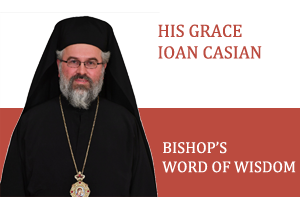
HG Bishop Ioan Casian served at the Bogdana monastery (Rădăuți)
the royal necropolis of the first Moldavian kings
On Sunday, February 12, His Grace Bishop Ioan Casian served at the Bogdana Monastery in Rădăuți. In the morning, the hierarch of Canada was greeted by a group of priests and deacons led by the abbot of the monastery, Archimandrite Irineu and Rev. Archpriest Ionel Constantin Maloș.
After the hierarch venerated the holy relics of St. Leontie of Rădăuți and St. Teodosie of Brazi, the clergy entered the new church where the Divine Liturgy was performed.
At the end of the service, the hierarch delivered a homily saying:
"We started the period of the Triodion – a preparatory period for welcoming the feast of the Resurrection of the Lord. It is a pilgrimage of all of us with a particular sense of need for prayer, fasting, almsgiving, etc. which brings us closer to God through repentance. We need models in this period to inspire us in what we do.
If we want to do something significant from a Christian point of view and we do not know how to do it, we must look in our Christian calendars to see the sanctifying examples. Approaching certain saints shows us a calling similar to those. It guides us in a certain practical direction that is useful to us. Let us have the audacity to approach and read their lives and further to follow their deeds. By looking at how they started their lives and doing the same deeds let us try to achieve the same results that they achieved."
Speaking about the Gospel of the day, the hierarch said:
"The 34th Sunday after Pentecost talks about the Gospel of the return of the prodigal son. It draws our attention to one thing, that of the fact that sincere repentance is a powerful tool that brings us back to God the moment we have turned away from Him. It is the power by which our sins are forgiven by God and we are restored to the condition of the Adamic beginning.
Through repentance man comes to his senses. This expression shows us that the man who comes to himself, who lived in sin and error, was living apart from himself. He was not living his own life but an external one, inspired by the evil one, passionate. He lived somewhat in an imaginary life, inconsistent with his own vocation, his own self, or the will of God. Man through repentance returning to himself begins to live his own life."
Next, His Grace showed how sin affects the love of God and neighbor and how important is the forgiving power of the father:
"The parable shows us that the mistake against the neighbor, in our case against the father, is a mistake against God at the same time. 'I have done wrong in heaven and before you. I no longer sound worthy to be called your son. Make me one of your servants.’ The reverse is equally true. A wrongdoing before God brings with it wrongdoing against the neighbor. Sin has a double consequence against the commandment of love for God and neighbor.
The commandment of love says - love the Lord your God and your neighbor as yourself. We owe love to God as Creator and Redeemer. Love of neighbor is due to the image of God that is in each of us. There is no Christian love without the two coordinates. We will easily tip in one direction or another if we do not maintain this balance: without God in a horizontal society where every opinion of a man no longer belongs to truth but to relative and aleatory way of thinking; without the neighbor we cannot show love to God because it is manifested through the attitude towards our neighbor."
"In this parable, instead of seeing a father angry because of his son's deeds, we see one who joyfully runs to embrace him, telling his servants to bring the best robe, the ring, the sandals for the prodigal son and to go and slaughter the fatted calf because the one he thought he was dead has risen, and the one he thought lost was found again. The father did not even wait for the son's words of repentance but understood that this sad experience of poverty brought his son back. The son understands that sin brought about his fall from his state of sonship."
The hierarch of Canada further showed how one of the commentators of this pericope practically understands the gestures of the father of the prodigal son:
"St. Peter the Chrysologus interprets this parable as follows: The Father who runs to the Son is God who runs in Christ towards the human person. The one who comes down to humanity is God. Man lost by sin waits for God to come down in the flesh.
The fact that the father laid his head on his son's shoulder means nothing more than the taking on of human nature by God in Christ. God in Christ embraces all humanity. Christ is a divine person who includes in Himself the two natures - divine and human. But Christ is without sin, the image of the Father.
The robe he gives him is the robe of glory. In the Church through Baptism, we receive the robe of the glory of the forgiveness of sins resulting from the work of Christ in the Holy Spirit. By this we are again given the opportunity to have a new beginning of pure life, a new foundation of life directed towards the kingdom of heaven. Christ did not need to be clothed in divine glory because He is the Father's divine light and glory. He clothed the humanity He put on by incarnation in this glory.
We see these experiences of divine glory in the lives of the saints - the hermits of Egypt, St. Simeon the New Theologian, St. Seraphim of Sarov, etc. This is how God bestows gifts that we don't always know how to use. This is how God clothes us in the robe of glory the moment we repent. We clothe ourselves again in the robe of the first Adam.
The ring that the son receives is the honor he acquires from his father, the consecration of the unbreakable and noble bond with his father as a son, similarly to the spouses, bound in the condition of fidelity and equal spiritual height but depending of course on each one's particular vocation.
The new sandals mean the proclamation of the Gospel. The one who receives the forgiveness of sins by God cannot help but talk about Him and the Gospel. When one knows the goodness of God, one cannot help but talk about Him. He is like a full vessel from which overflows the joy of God's blessing.
When we draw near to God and do what is right, we will be filled with His presence because He pours out His grace that fills our heart and life.
During the period of fasting, we open our heart and mind, our own life to the work of God's grace through repentance. Let us open the windows of our lives to the work of God's grace. This is the true work of fasting."
At the end, the hierarch of Canada addressed some exhortations to those present:
"In a world that is not always encouraging for us Christians in what we see, we must have the strength to pray and act in favor of peace, communion and closeness between human persons and between peoples. Here very close we have a fratricidal war in which the most innocent and defenseless die most of the time. The conflict is close to us through the suffering it causes to those of us who live physically far.
Although we live in a highly informed society, this does not seem to drive away conflicts. Information is important but it does not always remove conflicts; even sometimes it incites to them. That is why the Church has its role to preach forgiveness and to bring love and peace among people."
In conclusion, the hierarch of Canada thanked His Eminence Calinic, Archbishop of Suceava and Rădăuți, for the blessing to serve, Archimandrite Irineu for invitation, Archpriest Maloș, the clergy and the faithful for their presence. In turn, Archimandrite Irineu thanked the hierarch for the visit and presented him with an icon of St. Leontie of Rădăuți and an album.
A fraternal agape followed in the presence of city officials, the community, and a few guests.
In the afternoon of the same day, HG Bishop Ioan Casian visited the St. Leontie of Radauti Children's Home and obtained more details from Mother Ecaterina, the coordinator of the center.
The day ended in the evening with a visit to the Sihăstria Putnei Monastery where he met Archimandrite Nectarie, the abbot of the monastery.