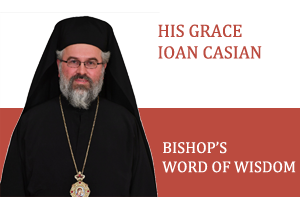
† IOAN CASIAN
by the mercies of God
Bishop of the Romanian Orthodox Diocese of Canada
To our beloved Clergy and Orthodox Christians,
peace and joy from Christ the Lord,
and from us hierarchical Blessings.
“But as many as received Him, to them He gave the right to become children of God,
to those who believe in His name: who were born, not of blood, nor of the will of the flesh,
nor of the will of man, but of God.”
(John 1, 12 - 13)
Most Reverend Fathers,
Beloved Faithful,
Christ is risen!
We are celebrating the Feast of joy and light, the Feast of feasts. The Orthodox Church rejoices in the victory over sin and death of our Lord who is "the beginning, the firstborn from the dead, that in all things He may have preeminence." (Colossians 1, 18)
“We celebrate the victory over Death, the destruction of the deep abyss, and the birth of a new eternal life. With joy, we praise the Author of all things, the only Blessed One, God of our fathers, for He is worthy of all praise”[1] proclaims one of the troparia of Matins of Resurrection.
Why this triumphant and liberating joy?
The Scripture speaks of the creation of man according to the image and likeness of God.[2] The human person was to be the reflection of the unseen and limitless One in the creation made by Him. Every person was meant to contemplate in their fellow human beings the joy of God's image and the beauty of their deeds on the way to achieving the likeness. But the profound harmony and unity of this first foundation would crumble because of the temptation of the evil one and by disobeying the word of God, which caused fear, shame,[3] and ultimately, death. The profound unity of human hypostases would be broken and the self-justification, pride, the struggle for survival and other passions would become a permanent presence in man’s everyday life. The Sacred Scripture presents, in its narrative, this ambivalence of the creation: its intrinsic beauty as a reflection of the providence of God, and its disorder due to sin.
So, what is the significance of the Holy Easter night for us, Orthodox Christians, and for the whole Church?
Our greeting Christ is risen! already synthesizes the good news for a new world, a better world, in full communion with God. On the joyous night of the Lord’s Resurrection, the sadness of death and of our drifting away from God disappears, because "the risen Christ gives His victory to each one of us with His two hands"[4] says St. Nicholas Velimirovici. On the night of the Resurrection, man is called from death to life; he is endowed with the victorious power of Christ's uncreated and eternal light over the chaotic time of darkness, powerlessness and disorder. Our humanity, restored in the risen Christ, avails itself to the transcendent and the eschaton, becoming leaven for everyone unto revival, renewal and transfiguration. We are once again offered the possibility of becoming sons and daughters[5], children of God through grace and "fellow citizens with the saints and members of the household of God." (Ephesians 2, 19).
We should ask ourselves: which is the path that leads to our primordial vocation? Christ offers Himself to us. But how does the power of His resurrection work in us? How does Christ's victory, through His Resurrection, become our victory? How can we regain the likeness with our Creator?
St. Basil the Great shows us the inner dynamics through which the image and likeness of God work in man toward his spiritual restoration, growth and development:
"In our initial structure – says the Cappadocian Father - co-originates and exists our coming into being, according to the image of God. By free choice we are conformed to that which is according to the likeness of God. And this is according to free choice: the power is within us and we make it active through our deeds…. Having given us the power to become like God, He allows us to be artisans of our likeness to God, so that the reward for the work would be ours."[6]
St. Basil the Great talks here about the harmonization of the inner work of the image, as the gift of God to man, with that of the likeness as man’s free and responsible choice through a theandric work in the Church.
St. John the Evangelist adds two essential elements: our acceptance of Christ and faith in Him[7] - which help us understand the way the human person enters the dynamics of renewal in God. The acceptance of God restores the primordial bond between man and God. The doors of the human soul are opening to receive the Creator. The joy of friendship with a hint of eternity reveals its dawn. The 'Sunrise from above' sends its rays to shatter the abyss of darkness. The faith in His name remains the element of permanence that maintains the possibility of making this journey in an authentic way. Faith sustains man’s reason enlightened in the choices he makes by guaranteeing their authenticity.
Once again, here is how the great Cappadocian understands the role of our accepting God and our faith in Him: "As a reason-endowed being I have that which is according to the image (of God), but I gain the likeness (of God) by becoming a Christian."[8] The acceptance of God means to assume freely man’s rational condition while the faith in His name draws man closer to the Christian ethos. The Risen Christ is the solution to man’s sin and death. Man is putting on Christ by living the life of God in his inner intimacy. God's will becomes man’s will. Thus, each person will be renewed not according to the pattern of an immanent human ideology, but according to the pattern of the eternal life inspired by the Holy Spirit. The rebirth into the new life is made “not of blood, nor of the will of the flesh, nor of the will of man, but of God.” (John 1, 13) This way, man regains his primordial vocation through the inner unity of spirit and reason, reflected in his deeds.
Beloved faithful,
This is the year of Homage to the Unity of Faith and nationhood, and the Commemorative Year of those who achieved the Great Union of Romania in 1918. This centenary has a special symbolic value for the Romanian faithful of our Diocese. Christian faith and the Church have been an intrinsic part in the birth of our nation and its Christian identity through the preaching of St. Apostle Andrew on the territory of the actual Dobrogea.
The Orthodox Faith and the Church have been the sustaining elements of the unity and the conscience of a common origin in faith and nationhood. The common ethos shaped by them prevailed over the difficulties resulting from the geographical position, the encounter of the Latin, Greek and Slavic cultures and the Orthodox, Roman Catholic and Protestant traditions. The Romanian identity and unity is based on what Father Dumitru Stăniloae identifies as the foundation of the entire Orthodox Church, namely "Jesus Christ Himself with His sacrificed and risen body in her depths. ... The unity of the Church ... is an ontological - spiritual unity in Christ and in the Holy Spirit."[9]
Certainly, the moment of 1918 was a fulfillment and a climax. But this moment of unity of faith and nation would not have been possible without saints such as: the Apostle Andrew, the protector of Romania, Efrem or Teotim bishops of Tomis, Epictet and Astion, Filofteia from Curtea de Arges, Ioan Casian, Paisie of Neamt, Nicodim of Tismana, Paraschiva from Iasi, Teodora from Sihla, Ghelasie from Râmeţ, Sava Brancovici, faithful kings Constantin Brâcoveanu, Neagoe Basarab and Stephen the Great of Moldavia, Varlaam and Dosoftei metropolitans of Moldavia, Iosif the New of Banat, Antim and Gregory of Ungro-Vlahia, Andrei Saguna of Transylvania and many others. Let us not forget also the metropolitans Sofronie of Moldavia and Nifon of Ungro-Vlahia, the bishop, metropolitan and first patriarch of Romania Miron Cristea and King Ferdinand the Ist. Here is a cloud of witnesses who, through faith, life and word, have achieved and maintained our unity of faith and nation. In the same spirit of unity, we should include our predecessors on the North American continent: Bishops Policarp and Andrei, Archbishop Victorin and Archimandrite Vasile Vasilachi, to mention only a few. Through their inspiring sacrifice, they resemble Christ, for “greater love has no one than this: to lay down one’s life for one’s friends.” (John 15, 13).
The historical event of establishing the Romanian Orthodox Diocese of Canada constitutes a renewed opportunity for us for an increased mission and confession of faith in the apostolic spirit of unity, holiness and sobornicity. Let us emulate the aforementioned saints and confessors, for they are our wise and faithful guides for the unity of faith and nation, through the storms of this world, towards the harbor we all hope to attain: the kingdom of God and the salvation of our souls.
Let’s become ourselves proud bearers of this living tradition of an apostolic Church, present and confessing, of a prophetic Church, inspired by the Holy Spirit for our time.
On the occasion of the Feast of the Lord’s Resurrection, we extend our thanks to all the clergy and devout people of the Romanian Orthodox Diocese of Canada and wish you all unity, spiritual joy, health, peace and many blessings from our Lord Jesus Christ!
Christ is risen!
Yours in prayer to the Risen Lord,
† IOAN CASIAN
Saint-Hubert / Montreal 2018
[1] Ode 7th
[2] Genesis 1, 26 - 27
[3] Genesis 3, 6 - 10
[4] Homilies to the Gospels on Sundays and Feasts. Ed. L’Age d’Homme, Lausanne, Switzerland 2016 p 230 – 231
[5] 2 Corinthians 6, 17 - 18
[6] On Human Condition. (First Homily 1.6) St Vladimir’s Seminary Press: Crestwood, New York 2005, p 43 - 44
[7] John 1, 12
[8] ibidem note 6
[9] Dogmatic Theology. (vol 2) Ed. EIBMO: Bucharest 2010, p 269 - 270