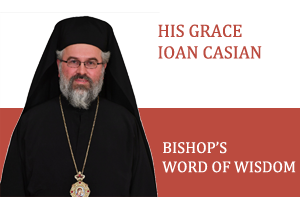
His Grace Bishop Ioan Casian: Priest Zechariah – An Example of the Passage
from the Silence of Unbelief to the Spirit-Filled Fullness of Proclamation
On the feast day of the Nativity of St. John the Baptist, the faithful of St. John the Baptist and St. Calinic of Cernica Cathedral in Montreal joyfully celebrated one of their heavenly protectors.
His Grace Bishop Ioan Casian, Romanian Orthodox Bishop of Canada, was present for the occasion.
The Holy and Divine Liturgy was celebrated by the hierarch together with several clergy members from the Montreal region: Fr. Traian Petre Constantin (parish priest), Protosyncellus Maxim Morariu, Fr. Ioan Iancu, Fr. Constantin Ciubotariu, Fr. Ion Ceaușu, Fr. Daniel Ungureanu, and Fr. Marius Constantin Popa.
At the conclusion of the Divine Liturgy, His Grace Bishop Ioan Casian delivered a sermon in which he interpreted the Gospel reading appointed for the feast.
The hierarch emphasized that this feast holds a unique place in the life of the Church because it honors the one entrusted with the singular mission of preparing the way for Christ the Savior:
“Today’s Gospel speaks about the announcement of the conception and birth of the Great Prophet, the one whom Holy Scripture calls the Forerunner, the one who would go before the Savior and prepare His way.”
“The ministry of St. John the Baptist continues the calling of all the prophets of the Old Testament: to turn the hearts of people toward God and to prepare the people for their encounter with Him.”
Reflecting on the miraculous announcement of St. John’s conception, the bishop recalled Old Testament examples—Abraham and Sarah, Manoah and his wife—showing that God works beyond the limits of human ability:
“God intervenes in human history, granting children to barren families and thereby revealing His power and strengthening the faith of those who follow Him.”
Interpreting the words, “He will go before Him in the spirit and power of Elijah, to turn the hearts of the fathers to the children and the disobedient to the wisdom of the righteous,” the bishop explained that this calling remains relevant for Christian families today, where faith is transmitted through the example of one’s life and where true wisdom is acquired through faith:
“Faith is transmitted above all through the life we live. Children learn not only from what they are told, but also from what they see as an example, especially within the family. They are formed within the framework of the faith that their parents profess and live out in family life. Likewise, the ministry of St. John the Prophet is one of awakening faith and awakening awareness of God’s presence. Through faith, a person acquires true wisdom, the wisdom ordained by God for human salvation.”
“In the angel’s words, we see the vocation that the Lord’s Forerunner would receive. Everything is the result of the presence of the Holy Spirit.”
The Bishop of Canada then drew a parallel between Zechariah’s dialogue with the angel and the Annunciation to the Virgin Mary, emphasizing the work of genuine faith:
“We see in Zechariah’s muteness, following the vision he received and the message that was announced to him, that doubt still remained in his heart, manifested through his inability to speak concerning what was to come. This muteness was removed when the child was given the name John. In the case of the Archangel Gabriel’s appearance to the Virgin Mary at the Annunciation, the situation is different. Although she receives a message that is humanly incomprehensible—the conception beyond human nature—she reflects upon it and asks a question, but accepts it with a pure heart: ‘Behold the handmaid of the Lord; let it be to me according to your word.’”
The bishop then spoke about Zechariah’s transition from the silence of doubt to bold confession through the work of the Holy Spirit:
“Like any human being, Zechariah probably harbored doubt in his heart when faced with the difficulty of having children. The same happens to us when we encounter difficulties in life; doubt enters our hearts and we begin to question God’s work. A person tends to examine himself more in times of hardship than in times of joy, which often seem natural and therefore do not challenge him.”
“The confession of the Forerunner’s name as John represented a departure from the tradition practiced in Israel, where a child would typically receive the name of his father or family line. Zechariah confirmed what Elizabeth had already declared—that the child’s name would be John. This testimony was a confirmation of their obedience to the words of the angel, and therefore to the words of God. This obedience brought about Zechariah’s release from muteness and the joy of both himself and the community, who could visibly and tangibly witness God’s work. At that moment, Zechariah was filled with the Holy Spirit and began to praise God and to speak, inspired by the Spirit, about the future mission of St. John the Baptist.”
At the conclusion of his homily, the bishop encouraged the faithful to rejoice in this feast and to follow the example of St. John the Baptist in zeal for God and in fulfilling His word.
Fr. Traian Petre Constantin parish-priest then expressed gratitude to the bishop, the concelebrating clergy, and all the faithful who participated in the celebration.
Following the Divine Liturgy, the entire community was invited to the traditional “liturgy after the Liturgy,” the festive parish meal organized on the occasion of the cathedral’s feast day. A short artistic program dedicated to the Romanian poet Mihai Eminescu was also presented.
The Feast of the Nativity of St. John the Baptist thus became an occasion of prayer, fellowship, and spiritual strengthening for the Romanian Orthodox community of Montreal.
(contribution by Nun Ana Bulgariu)