His Grace Bishop Ioan Casian Calls for Responsibility and Witness
on the Sunday of the Myrrh-Bearing Women
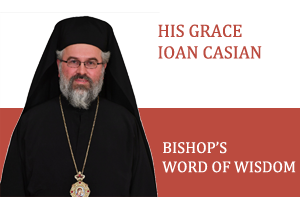
On the Sunday of the Myrrh-Bearing Women, His Grace Ioan Casian, the Romanian Orthodox Bishop of Canada, served at the Episcopal Cathedral of St. Great Martyr George and St. Epictetus and Astion in Saint-Hubert, Quebec, Canada. Concelebrating with him were Fr. Mircea Panciuk, Fr. Adrian Manea, Fr. Marius Constantin Popa, and Deacon Valenti Boțu.
At the end of the Divine Liturgy, before the sermon, selected members of the newly formed Parish Council who were present took their oath, assuming responsibility for their service before Christ and the Church, the bishop, and the community. This moment gave concrete meaning to the words that followed in the bishop’s sermon, linking the Church’s teaching with the life of the community.
At the beginning of his address, the hierarch emphasized the dual significance of this Sunday: “The Church celebrates the Sunday of the Myrrh-Bearing Women (…) and for us Romanians, this Sunday takes on a special meaning, since, starting this year, it has also been established as the Feast of the Synaxis of Romanian Holy Women.” This new feast highlights “the sixteen women recently canonized,” as well as, more broadly, “all faithful women who, throughout history, have suffered and confessed the faith.”
Drawing from the day’s readings, the bishop first emphasized the teaching from the Acts of the Apostles, noting that service in the Church is not an individual initiative, but a calling: “no one takes on a ministry on their own, but is called and appointed by God through the Church.” Faced with the risk of losing sight of the essential mission of proclaiming the Word of God, the Apostles ordained the seven deacons in order to remain faithful to their calling of “steadfastness in prayer and in the ministry of the word.”
This order is not merely organizational, but deeply spiritual: “when secondary concerns become dominant, the essential risks being lost.” This message resonated especially in the context of the Parish Council’s oath, serving as a reminder of each person’s responsibility in the life of the Church.
In the second part of his sermon, the bishop highlighted the witness of the Myrrh-Bearing Women, emphasizing their courage and faith: “They are the first to go to the tomb… the first to receive the news of the Resurrection.” The words of the angel—“Do not be afraid… He has risen, He is not here”—become the foundation of this witness.
Moreover, the women receive a unique mission: the words “Go and tell His disciples” make them, as the bishop noted, “apostles to the apostles,” the first heralds of the Resurrection. In a world where their testimony was often disregarded, their faith and obedience gain even greater strength, showing that the truth of the Resurrection is not symbolic, but “a real event that took place in history.”
The connection with the Sunday of the Holy Apostle Thomas was also emphasized: “if the Apostle Thomas confesses through seeing and touching the risen Christ, the Myrrh-Bearing Women proclaim through faith and obedience, based on the angel’s words and the discovery of the empty tomb, thus completing the witness of the Paschal faith.”
In this context, the Feast of the Sobor of Romanian Holy Women appears as a living continuation of this testimony: “their lives are living examples of faith, patience, and sacrifice.” Their diversity—from wives of rulers to monastics, from mothers to confessors in communist prisons—shows that “holiness is not tied to a particular social status, but to faithfulness to God.”
In a world marked by challenges and confusion, these models become guiding lights: “we are called to learn about their lives, follow their example, and strengthen our faith, so that we too may bear witness to Christ in today’s society.”
After the liturgical service, all those present were invited to a traditional agape organized in honor of St. George, the protector saint of the cathedral, prepared by the Parish Council and women actively involved in the community’s life—an occasion that naturally extended the joy of liturgical communion.
In this context, His Grace Bishop Ioan Casian also recalled an important community project: the renovation of the cathedral’s basement and its transformation into the Multifunctional “Diaconia” Center, a space dedicated to gatherings, education, and social and cultural activities. It will host initiatives for children, youth, and adults, as well as AROLA activities and the Sunday school, becoming a vibrant center of parish life.
The day concluded under the sign of a double calling: responsibility and witness. As the bishop emphasized, following the example of the Myrrh-Bearing Women and the holy women of our history, “every believer is called to transform faith into life, becoming a living witness of Christ’s Resurrection in the world.”
(notes by Nun Ana Bulgariu)