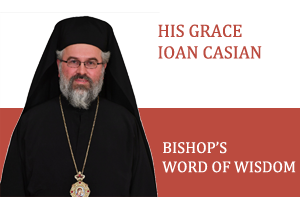
His Grace Bishop Ioan Casian: The Spiritual Life Is the Fruit of the Work of God’s Grace in Us
On the Second Sunday of the Holy and Great Lent, dedicated to Saint Gregory Palamas, His Grace Bishop Ioan Casian celebrated the Divine Liturgy at the Episcopal Cathedral of St. Great Martyr George and Sts. Epictetus and Astion in St-Hubert, Québec. Concelebrating with the hierarch were: Fr. Mircea Panciuk – Protopresbyter Emeritus, Protosyncellus Maxim Morariu – Ecclesiarch, Fr. Constantin Lupașcu, Fr. Adrian Manea, and Deacon Valentin Boțu.
At the end of the Divine Liturgy, the hierarch addressed the faithful with a homily on the spiritual meaning of fasting and on the real encounter between the human person and God, emphasizing that the period of Great Lent is a spiritual journey that leads to the great event of the Resurrection of the Lord.
“Great Lent is a spiritual pilgrimage toward the encounter with the great event of the Resurrection of our Lord Jesus Christ. It involves an inner effort, a spiritual work that we have already begun to experience during the first week of the fast, especially marked by the Great Canon of Saint Andrew of Crete and by the services specific to this period.”
The Work of Grace in the Life of the Human Person
The hierarch underlined that the path of spiritual purification is not only the result of human effort, but above all the fruit of God’s grace.
“We must understand that it is not we who, by our own strength, succeed in putting our lives in order. What we can do is become available to the work of God, open our hearts, and desire through prayer that He may come and dwell within us.”
The spiritual life, the bishop explained, is an inner journey described by the Holy Fathers of the Church, whose writings are gathered in the Philokalia.
“Sometimes the word ‘spiritual’ may seem abstract to us, but when someone truly enters this path, they begin to feel the purifying work of God’s grace touching the human heart and mind.”
The Christian Faith – Founded on Real Testimony
His Grace Bishop Ioan Casian also emphasized that the Christian faith is not based on myths or philosophical ideas, but on a historical reality: the life and work of Christ the Savior.
“The message of salvation that we receive in the Church is not a story or a legend. Our faith in the incarnation of the Son of God, in His life among people, in His suffering, crucifixion, death, and resurrection on the third day is founded upon real testimony. This testimony was transmitted by the Holy Apostles, witnesses of Christ’s life and resurrection.
The Church is called in the Creed ‘one, holy, catholic, and apostolic.’ It is apostolic because it is founded on the witness of the Apostles, who proclaimed to the world what they had seen and experienced.”
The Role of Faith and the Divine Authority of Christ
Commenting on the Gospel of the Sunday, which recounts the healing of the paralytic in Capernaum, the bishop highlighted the faith of the four men who brought the sick man before Christ.
“The Gospel says something very important: ‘When Jesus saw their faith.’ Christ observes the faith and love with which these people brought their friend before Him. The words spoken by the Savior — ‘Son, your sins are forgiven’ — reveal His divine identity.
He does not pray to God for the healing of the man, as the prophets of the Old Testament did, but speaks with His own authority: ‘Son, your sins are forgiven.’”
The Church – The Place of Encounter with God
The house in which Christ was speaking to the people and healed the sick man can be understood as an image of the Church.
“The house mentioned in the Gospel may be understood, in a spiritual interpretation, as an image of the Church. In a similar way, when the Holy Scriptures are read in the assembly of the faithful, they are proclaimed in the Church, which is the house of God.”
At the same time, the gesture of the four men who opened the roof of the house symbolizes the removal of the hardened will of the human heart.
The roof that is taken away symbolizes precisely this hardened will, this blindness caused by sin, which must be removed through the grace of God and through our own spiritual effort.”
The Teaching of Saint Gregory Palamas
In the second part of his homily, the bishop explained the theological significance of this Sunday dedicated to Saint Gregory Palamas.
“Saint Gregory Palamas showed that between God and humanity there is a fundamental difference: God is uncreated, while the human person is created. For this reason, the divine essence cannot be grasped by human understanding. Yet God remains present and active in the world through His uncreated energies. These energies are the work of God through which He shares Himself with human beings and through which our lives are transfigured. In this way we understand how the grace of God continues to work in the Church.
The spiritual life is not exclusively the result of our efforts, but the work of God’s grace within us.”
The Witness of the Saints in Every Generation
In his homily, the bishop also mentioned the example of the newly canonized Holy Priest-Martyr Liviu Galaction, as well as the witness of holy women.
“The life of the Holy Priest-Martyr Liviu Galaction shows that holiness does not belong only to a distant past. The grace of God works in every generation. At the same time, the Church brings to light the witness of holy women — nuns, wives, and mothers — as models of faith and sacrificial love.”
A Call to Spiritual Life
In conclusion, His Grace Bishop Ioan Casian encouraged the faithful to use the time of Great Lent as an opportunity to draw closer to God.
“Fasting, prayer, participation more frequently to the religious services, the reading of Scripture, and almsgiving are the means through which the Church helps us grow spiritually and draw closer to God.”
At the end, the hierarch blessed all those present and congratulated all mothers and women, offering each of them a rose on behalf of the clergy and the parish council, as a symbol of gratitude, respect, and appreciation for the work they do within the life of the Church.
(notes by Nun Ana Bulgariu)