The Asymmetric Response of Love: Love is not overcome by evil, but overcomes evil with good
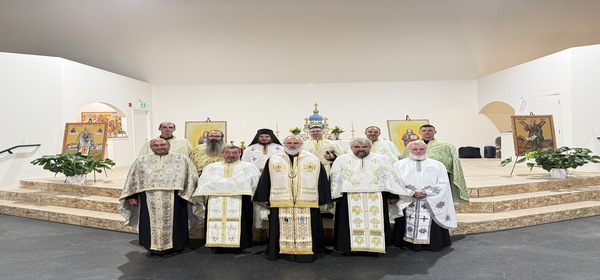
On the 19th Sunday after Pentecost, His Grace Bishop Ioan Casian celebrated the Divine Liturgy among the faithful of St. Andrew Parish in Calgary, Alberta. The parish also hosted the Deanery Meeting of the Western Canada on October 3 - 4, 2025.
Concelebrating with the bishop were: Fr. Călin Maricaș (Dean), Fr. Vasile Moisi (parish priest), Fr. Corneliu Iulian Dragomir, Fr. Lucian Moldovan, Fr. Ovidiu Moldovan, and Fr. Ioan Cristian Bujor.
In his homily delivered at the end of the service, the hierach spoke to the faithful about the importance of loving one's enemies in the context of salvation:
“If you love those who love you, what reward do you have? — with this challenging verse, the Gospel of the day calls us to an attitude that is foreign to both the ancient world and modern society: love for one’s enemies. This is, in fact, the core and center of the message of today’s Gospel.”
The bishop went on to speak about the power of God made manifest in human weakness:
“Before this Gospel exhortation, the Holy Apostle Paul teaches us a lesson in humility and trust in the work of grace: if we acknowledge our weaknesses and frailties, we must understand that in them the power of God is revealed. The Apostle testifies that he received ‘a thorn in the flesh,’ for which he prayed earnestly, but the answer he received was clear: ‘My grace is sufficient for you, for My power is made perfect in weakness.’ Therefore — says St. Paul — ‘I will boast all the more gladly about my weaknesses, so that Christ’s power may rest on me.’”
“This teaching overturns the logic of the world. Christ did not choose His disciples from among the most educated or the elite of His time, but from fishermen, tax collectors, myrrh-bearing women — simple people. He chose them for their purity and their willingness to give themselves wholly.
The work of God does not require the visible strength of this world. It is mysterious, spiritual, like a gentle breeze, as at the Descent of the Holy Spirit — discreet, yet full of power. God reveals Himself not in thunder and lightning, but in the gentle whisper of the wind.”
Referring to the message of the Gospel and its relevance to today’s society, the Romanian hierarch noted that the Gospel proposes an “asymmetric logic,” contrary to instinctual reactions:
“We live in an age of conflict and violent responses. In such a context, Christ comes and proposes another logic: the logic of love, of gentleness. If we respond only symmetrically — love for love, good for good — we do no more than what pagans or unbelievers do. The Gospel calls us to love even those who do not love us, to do good to those who oppose us. This is where the true difference between human love and Christian love lies. When we respond to evil with good, to hatred with forgiveness, to aggression with love, we become like Christ.
The Savior gave us the highest example: Though betrayed, mocked, and persecuted, He prays from the cross: ‘Father, forgive them, for they do not know what they are doing.’ This is the true measure of Christian love — a love that is not overcome by evil but overcomes evil with good.
Thus, today’s Gospel presents the image of the true Christian, called to rise above the instinct for aggressive response and to transform adversity into an opportunity for spiritual growth. It is not easy, but it is an ascetic labor, a work of the heart.
St. Ambrose of Milan said that love for enemies is, in fact, God’s love poured into our hearts, which we, in turn, pour out to others, and St. Isaac the Syrian adds: ‘The merciful person endures injustice.’”
The bishop also mentioned the newly canonized saints of the Romanian Patriarchate during this centennial year: 16 monastic and priest-martyrs, confessors from the communist era, as well as 16 women saints: “Their lives form a powerful testimony of patience and love in the face of suffering. They show us that even modern ideologies and societies that pride themselves on being ‘civilized’ can give birth to monstrosities and persecutions.
The grim statistics of those communist regimes — over 90 million victims — are a stark warning of what humanity can become when it turns away from God and loses spiritual vigilance.”
In conclusion, the Bishop of Canada stated: “Today’s Gospel calls us to an attitude contrary to the logic of violence: to generosity, love, and forgiveness — to that asymmetric response we see in Christ Himself. He does not call us to passivity, but to the courage to be different; to rise above instinctive reaction; to respond in an unexpected way — not through force, but through love. This is true power: love is stronger than hatred, and kindness has the power to transform the world.”
“We live in an age of information where we witness — in real time — wars and conflicts, suffering, hunger, poverty, and injustice. What does this show us? That information, no matter how abundant, is not enough. What is missing is attitude. And attitude does not change through technology, but through faith and grace. Only the grace of the Holy Spirit can break the cycle of evil and transform the heart of the person who believes in the power of God’s work.”
The homily concluded with words of gratitude to the community of St. Andrew’s Parish in Calgary:
“Even though the Church is still under construction, you can feel that it is becoming more and more a living house of prayer. We thank the parish priest and the faithful who received us with love and patience, turning these days into a true example of love and communion.”
Following the religious service, the Romanian Bishop of Canada elevated Fr. Vasile Moisi to the rank of Iconom Stavrofor, awarded an anniversary medal of the Diocese to Mrs. Elisabeta Ștefan, and certificates of merit to Mr. Gheorghe Eftimie, Mr. Sherban Comănescu, and Mr. Gheorghe Crișan.
Fr. Vasile Moisi thanked the bishop and invited those present to a fraternal agape meal.
(contribution by Nun Ana Bulgariu)