The first hierarchical Liturgy in the new worship space
of St. Andrew Parish in Calgary
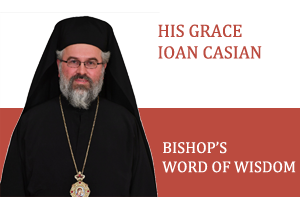
Between December 2-5, 2020, St. Ap. Andrew Parish in Calgary received the pastoral visit of His Grace Bishop Ioan Casian.
Saturday morning after a preliminary visit to the new worship space and the presentation of the initial plan for its arrangement as a church, the day continued with the Vespers service. Together with the hierarch of Canada, Fr. George Bâzgan administrative vicar, Fr. Mircea Panciuk dean for Canada West, Fr. Vasile Moisi parish priest dean, Fr. Călin Dorin Mărincaș, Fr. Lucian Constantin, and Deacons Ciprian Pavel and Gheorghe Petrovan were present.
At the end of the service, the hierarch of Canada spoke about the significance of the feast of St. Andrew the patron saint of the parish, of the Diocese of Canada and Romania, and about St. Andrei Șaguna:
"These days we celebrate the patron saint of your parish in Calgary - St. Andrew the Apostle the First Called. At the same time we also celebrate St. Andrei Șaguna – Metropolitan of Transylvania. Through the two, we celebrate the universality of the Church and its apostolic character, but also the specific way in which Orthodox Christianity manifested itself on the territory of Romania and the struggle it had to wage to preserve its identity and acquire rights on behalf of the Orthodox believers.
Through St. Andrew the Apostle, our Romanian Christianity is linked to the universality of the message of salvation in Christ of the apostolic community, of the first Church. The fact that St. Andrew, according to tradition, spent some time preaching the Gospel on the territory of Scythia Minor, i.e. in Dobrogea, gives our Romanian Christianity direct apostolic authority and a considerable historical depth. At the same time, the fact that we celebrate on the same day the great metropolitan of Transylvania from 19th century, St. Andrei Șaguna, fighter for the institutional-religious and social-cultural rights of Transylvanian Romanians, also gives our Christianity a local specificity. The Church was and is involved not only religiously but also institutionally, socially and humanly in the lives of believers. It is a side that gives the Romanian Orthodox Christian experience a visible practical aspect and a sensitivity marked by social dynamism structured and spiritually grounded on evangelical values.
This is important to remember because we live in a society where we need this visibility and 'social efficiency'. This aspect gives to our church life more consistency and social and human authority."
On Sunday morning, HG Bishop Ioan Casian was welcomed by the group of priests to whom Fr. Ovidiu Moldovan and the believers present at the church were added. The hierarchical Liturgy was served for the first time in the new place of worship after the pandemic period.
In the homily at the end of the Divine Liturgy, His Grace said:
"This Sunday it was read the story about the healing of the crippled woman. We see how Christ heals a woman with a long suffering of 18 years. The woman lived without being able to look at the sky being bent over. The earthly heaven as an image of the spiritual heaven, of eternity, could not be easily discerned by her because of her impotence. From the text of the Gospel it seems to be understood that the woman had this possibility in her youth to raise her eyes to heaven and address prayers to God being healthy. But for 18 years, due to impotence, she prayed with hope without being able to look at the hopeful sky.
The woman's faith makes her come to the synagogue, in the presence of God's word and grace in which she put her hope. This time, unlike other times, by faith she will be brought not only in the presence of God's word and grace, but in the presence of the Messiah, Jesus Christ, the Person of the Son of God incarnated from the Virgin Mary who will heal her.
It is interesting to note that unlike other healings in which Christ examines the faith of the sick person, He heals this woman without asking her anything. And this because, as Scripture says, He knew the heart of the woman and her life; He already knew the woman's faith and her long suffering. 'Woman, you are loosed from your infirmity' are the words He addresses to her and by laying hands on her He heals her. 'And immediately she was made straight and glorified God.' This is what it means to be healed of infirmity. She fully expresses her joy at regaining the health and naturalness of life that she had not had for a long time.
St. Nicolae Velimirovici says that 'the crippled woman represent the image of the debilitated thoughts that lead away from Christ. A debilitated mind - he says - is also bounded by the will of the senses. It knows nothing of God, nor of the spiritual world, nor of eternal life, nor of any higher heavenly joy; it is full of anxiety, fear, torment, sadness, and malice. The Savior Jesus Christ calls it to Himself through healing, to straighten it, enlighten it and make it happy. Healed, straightened, enlightened and happy, it will thank and praise God with all its powers.'
But for us this text means even more in relation to the Church if we take into account the Lenten period of the Nativity in which we find ourselves. This period is a period of spiritual and physical asceticism in which the Christian tries to renounce material things and focus on regaining the verticality of life through faith and deed. And the Church is the place where this must happen because it is the propitious environment that provides the means placed at our disposal by God to accomplish this work.
The event of the Nativity is the target of the ascetic period in which we are. Fasting prepares us by simplifying our lives and progressively distancing us from the peripheral concerns of spiritual life. It directs our attention more and more to the event we are stepping towards which has totally changed our lives – the Birth of our Lord Jesus Christ from the Virgin Mary for us and for our salvation.
The paradise is the gift given to man to be in communion with God and fellow human persons in His presence. The different gifts given by God are gifts that were meant to be shared with others. Or it is precisely in the Church that we learn to repair our relationship with God by receiving the forgiveness of sins and fulfilling the commandments and that with fellow human persons by reconciling with those whom we have offended or distressed before participating in the Divine Liturgy. And the sealing of this is done by partaking in the Body and Blood of Christ the Savior in Holy Communion, which is the food of eternal life. In the Church we find the environment in which we heal our relationship with God and with our neighbor through the knowledge of good and evil as the foundation of the new life in Christ."
Speaking about the new place of worship acquired by the parish during the pandemic, the hierarch said:
"All of us as a spiritual family of the Church are glad with the achievement you made by acquiring a new building where you will be able to set up the new place of worship and the rest of the spaces necessary for the good development of religious and social life around a church. We congratulate you and encourage you to go forward. This project which is in development must be seen as the face of the project of the spiritual community of the church. The place of worship that you want to set up as a church is the image of the spiritual church in the souls of believers that we must not lose sight of. This is the most important thing."
The hierarch congratulated the Parish Priest Vasile Moisi, the Parish Council, and the church members for the purchase of the new space for the church made in the pandemic period which shows that God is present and works all time.
Rev. Fr. Vasile Moisi thanked all the participant clergy and faithful who, through their presence, transformed the feast of St. Ap. Andrew the patron saint of the parish into a true celebration of inter-parochial communion between members of several communities in western Canada.
The day ended with the traditional agape and an artistic program of traditional Romanian music and Christmas carols in which local artists participated.